


Introduction
Have you ever felt frustrated that your small business website just isn’t showing up on Google—even though you’ve put in so much time, effort, and money? You’re not alone. Many business owners face the same struggle. The hard truth is: without a clear keyword strategy, your website will stay invisible while your competitors keep getting all the clicks, calls, and paying customers.
It can feel discouraging when your website looks good but doesn’t bring in any real leads or sales.
The biggest reason behind this is weak—or sometimes no—keyword research. Without knowing what your customers are searching for, your website won’t show up where it matters.
The good news? In this easy, step-by-step guide, I’ll walk you through exactly how to do keyword research for your small business website. You’ll learn how to find the right keywords, use them naturally, and build a solid SEO foundation that helps your website finally get discovered online.
So, let’s jump into the 10 practical steps to keyword research for small business websites.
Step 1: Understand What Keyword Research Really Means
At its heart, keyword research is about finding the exact words and phrases your potential customers type into Google when searching for businesses like yours. It’s not about fancy marketing jargon—it’s about understanding how real people search online.
Think of keywords as a bridge: on one side, your customers are asking questions and looking for solutions; on the other side, your business has the answers. Without the right keywords, that bridge is broken—and your competitors are the ones customers will find instead of you.
As an example, let’s say you run a tiny website for cleaning services. If someone in your city types “house cleaning services near me,” but your site only talks about “residential sanitation solutions,” Google may not connect the dots. As a result, the customer never finds you—even though you offer exactly what they need. That’s the power of keyword research: using the same language your customers use.

Benefit: When you know and apply the right keywords, your website starts showing up for real customer searches. This means more visibility, more relevant traffic, and a much higher chance of turning visitors into paying clients.
Step 2: Identify Your Target Audience
Before you even start collecting keyword ideas, you need to clearly understand who your ideal customers are. Keyword research isn’t just about search terms—it’s about stepping into your customers’ shoes and thinking the way they think when they go online.
Ask yourself
- Who exactly are my ideal customers? (Are they busy parents, local homeowners, small business owners, students, or professionals?)
- What problems are they trying to solve? (Are they looking to save time, find affordable services, or get expert help quickly?)
- How would they describe my service in Google searches? (Would they type “budget-friendly accountant near me” or “small business tax consultant”?)
Example: Let’s say you run a small business SEO agency. Your potential clients—local shop owners, freelancers, or service providers—are unlikely to search for “advanced digital optimization services.” Instead, they’ll type in something simple and clear like “SEO services for small businesses” or “affordable SEO company near me.” By knowing your audience, you can pick the exact business website keywords that connect with their language, not just industry buzzwords.
Benefit: When you deeply understand your audience, you’re able to choose keywords that match their true intent. This means your website shows up for searches that actually bring in leads, not just random visitors. The better you align your content with your target audience’s needs, the faster you’ll build trust, attract qualified traffic, and grow your small business online.
Step 3: Brainstorm Seed Keywords
The next stage is to begin coming up with seed keywords after determining your target demographic. These are the broad, simple words or short phrases that describe what your business does at its core. Think of them as the “starting point” of your keyword research journey—the roots from which more specific keyword ideas will grow.
Seed keywords usually focus on your main products, services, or industry. They’re not too detailed, but they give you a foundation to build on later when you dive into long-tail keywords and local variations.
Examples of seed keywords
- “bakery in [city]” — if you are the owner of a neighborhood bakery.
- “accountant for small business” – if you offer accounting services.
- “SEO services for small businesses” – if you run a digital marketing agency.
A practical way to find seed keywords is to ask yourself: “If someone had never heard of my business before, what simple words would they type into Google to find me?”
Benefit: Seed keywords are your foundation. They may not always bring you instant rankings (since they’re often competitive), but they help you map out the bigger picture. Later, you’ll expand these seeds into long-tail keywords like “affordable SEO services for small businesses in [city],” which are easier to rank for and more aligned with customer intent. In short, strong seed keywords keep your strategy focused and give your website a clear direction for growth.
Step 4: Explore Keyword Research Tools
Once you have your seed keywords, the next step is to use keyword research tools to expand your list, check search volume, evaluate keyword difficulty, and analyze competition. These tools help you make informed decisions instead of guessing what your customers might type.
Here are some beginner-friendly options
- Google Keyword Planner (Free) – Perfect for checking search volume and competition, showing how often people search for a keyword and how difficult it may be to rank.
- Ubersuggest – A simple, beginner-friendly tool that provides keyword ideas, search trends, and content suggestions.
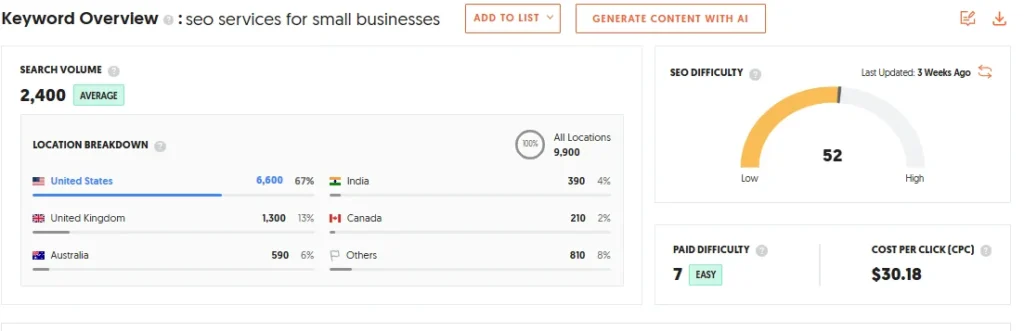
- Google Search Console – helps you optimize current pages by displaying the keywords that are already bringing visitors to your website.
- SEMrush / Ahrefs – Advanced tools for checking competitor keywords, tracking rankings, and analyzing keyword difficulty for more in-depth research.
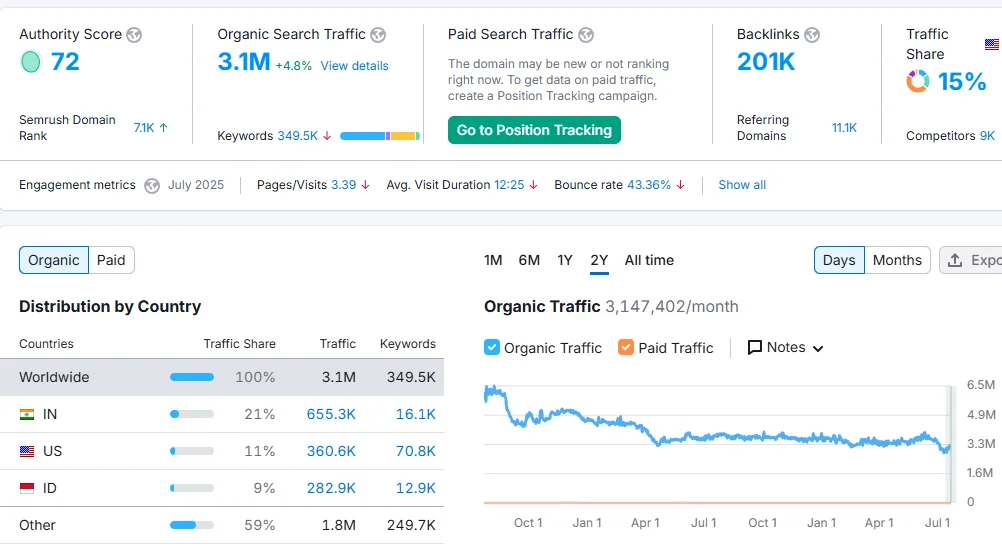
Benefit: Using keyword research tools saves you hours of guesswork. You get data-backed keyword ideas that help your website rank higher, attract the right audience, and generate potential leads from people actively searching for your services.
We deliver SEO services designed to help small businesses dominate search results and grow online.
Step 5: Analyze Search Intent
Every keyword your potential customers type into Google has an underlying “search intent”—the reason why they are searching. Understanding search intent is crucial because it helps you target the right people with the right content, rather than just attracting random visitors.
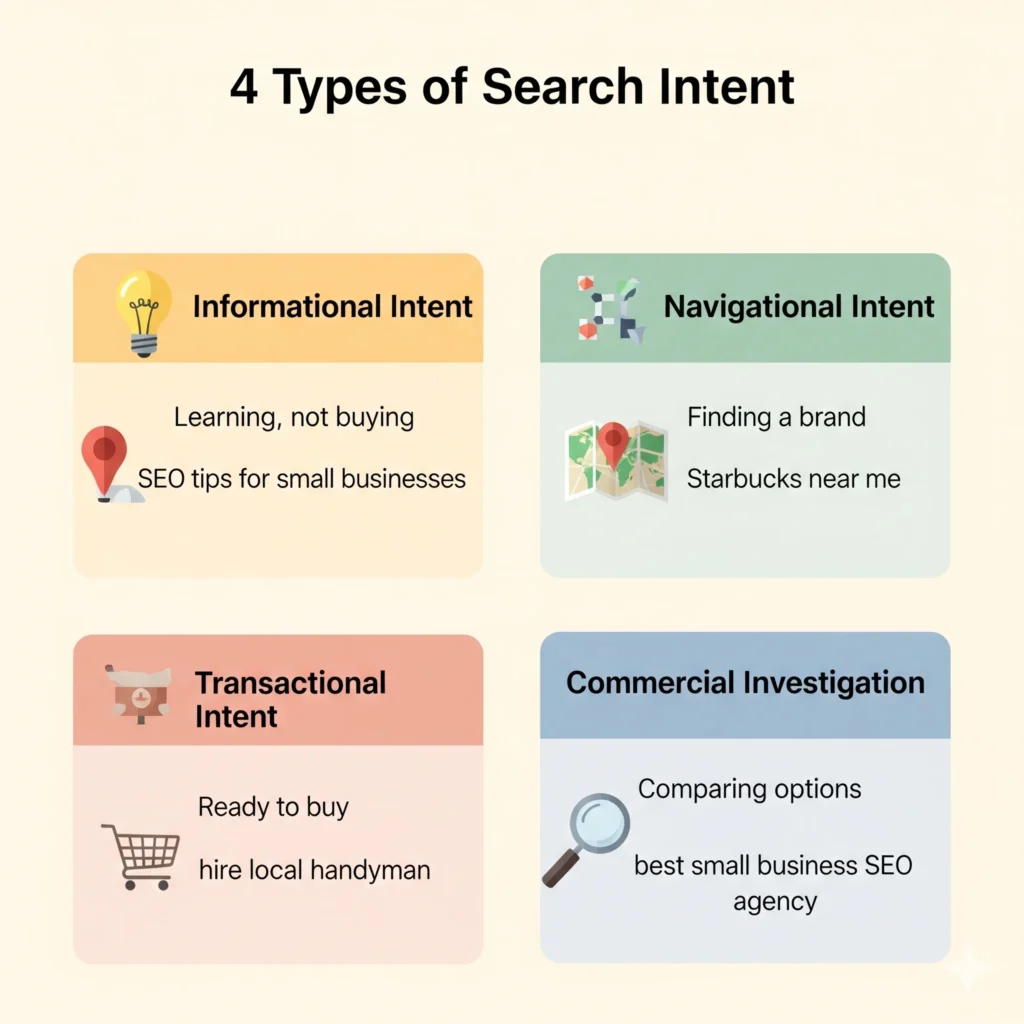
There are 4 main types of search intent
- Informational Intent – The searcher is trying to find information or direction. These searches are about learning, not buying.
- For instance, “SEO tips for small businesses” or “How to do keyword research.”
- Best for: Blog posts, tutorials, and educational content.
- Navigational Intent – The searcher is looking for a specific brand, business, or website.
- Example: “Starbucks near me” or “GlobalRankWeb SEO services.”
- Best for: Ensuring your business is easy to find online and your brand name ranks well.
- Transactional Intent – The searcher is ready to purchase a product or hire a service.
- Example: “buy custom cupcakes [city]” or “hire local handyman near me.”
- Best for: Local landing sites, service pages, and product pages.
- Commercial Investigation (Commercial Intent) – The searcher is considering options and comparing products or services before making a decision.
- Example: “best small business SEO agency” or “top laptops for students.”
- Best for: Comparison guides, reviews, and content that helps users make informed decisions.
Tip for Small Businesses: Focus on transactional, commercial investigation, and local keywords. These searches are from people who are actively looking to buy or hire, making them more likely to convert into paying customers.
Benefit: Understanding and targeting the right search intent improves your conversion rates, ensures your content reaches the right audience, and helps your website generate tangible results—turning clicks into real leads and sales.
Step 6: Find Long-Tail & Local Keywords
After determining your seed keywords and comprehending search intent, you should concentrate on long-tail and local keywords. These are crucial for small businesses because they are specific, less competitive, and more likely to attract customers who are ready to take action.
What are long-tail keywords?
- Long-tail keywords are longer, more specific phrases that reflect exactly what your customer is searching for.
- Example: “affordable wedding photographer in [city]” or “emergency plumber open now [city].”
- They usually have lower search volume than short-tail keywords, but the traffic they bring is highly targeted and more likely to convert into leads or sales.
What about short-tail keywords?
- Short-tail keywords, such as “plumber” or “wedding photographer,” are more comprehensive and broader.
- They have higher search volume but are very competitive, and visitors may not be ready to buy yet.
- Short-tail keywords are useful for understanding the market, but for small business websites, long-tail and local keywords often bring faster results.
Why local keywords matter:
- Adding your city, neighborhood, or region to a keyword helps you target customers nearby, which is especially important for service-based businesses.
- Example: “best SEO services for small businesses in [city]” ensures you attract leads who can actually hire you.
Benefit: Focusing on long-tail and local keywords makes it easier to rank on Google, brings in high-quality traffic, and connects you directly with people who are most likely to become customers. It’s a cost-effective strategy that helps small businesses compete with bigger brands without spending heavily on ads.
Want to see how these keywords fit into a complete SEO strategy? Check out our advanced SEO strategies for small businesses.
Step 7: Check Out Competitor Keywords
Once you have a list of potential keywords, it’s smart to look at what your competitors are doing. Understanding which keywords your competitors are ranking for can give you valuable insights and save you a lot of trial-and-error. This is not about copying them, but about learning what works in your industry and finding opportunities to create better, more targeted content.
Here’s how you can approach it
- Use tools like SEMrush or Ahrefs to discover which keywords are driving traffic to your competitors’ websites.
- You can also do manual Google searches to see which businesses appear in the top results for keywords you’re targeting.
- Ask yourself: Can I create content that’s more useful, informative, or engaging than what they already have?
- Look for gaps in their content—topics they haven’t covered well or keywords they aren’t targeting effectively.
Benefit: Checking competitor keywords helps you avoid guessing and gives you a proven strategy to follow. It also shows you what your audience is actively searching for and allows you to create high-quality content that can outrank competitors. By learning from others, you can refine your keyword research, improve your content, and increase your chances of attracting qualified traffic to your small business website.
Step 8: Organize Keywords with Keyword Mapping
Collecting a list of keywords is just the beginning. The real power comes from organizing them strategically so that each page on your website serves a clear purpose and targets the right search queries. This process is called keyword mapping, and it helps you avoid confusion, keyword overlap, and content gaps.
Here’s how to do it effectively
1. Group Keywords by Topic
- Categorize your keywords based on themes like services, products, or locations.
- This makes it easier to plan your website structure and blog content.
2. Assign Keywords to Specific Pages
- There should be a specific page or post for each collection of keywords.
- This prevents multiple pages from competing for the same keyword, which can confuse search engines.
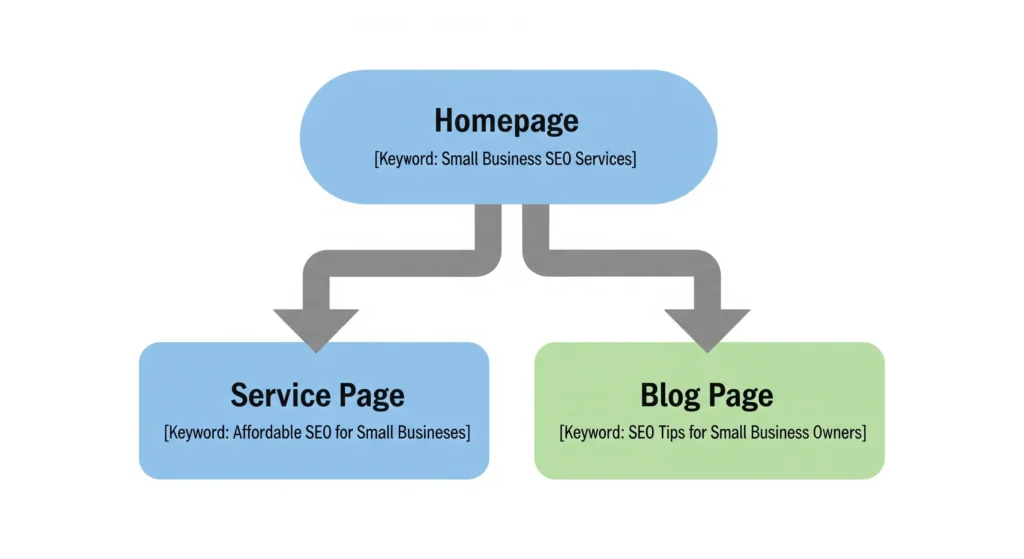
Example of Keyword Mapping
- Homepage: “SEO services for small businesses” – your main target keyword.
- Blog Post: “Step-by-Step Keyword Research Guide” – long-tail informational keyword.
- Service Page: “local handyman services in [city]” – local keyword targeting customers in your area.
3. Plan Future Content Around Gaps
- Identify keywords that don’t have a dedicated page yet and create content specifically for them.
- This ensures you cover all relevant topics for your audience without redundancy.
Benefit: Keyword mapping improves content optimization by clearly defining the role of each page, avoiding keyword cannibalization, and making it easier for Google to understand your website structure. Organized keywords also help you create a cohesive content strategy, attract the right audience, and maximize your small business website’s visibility online.
Step 9: Use Keywords Naturally in Content
Finding the right keywords is important, but how you use them matters even more. The most important rule for small business websites is: write for humans, not algorithms. Your keywords should support your content, not dictate it. Forcing them unnaturally into every sentence can make your content hard to read and less engaging.
Here’s how to integrate keywords effectively while keeping your content user-friendly:
Page Titles & H1 Headings
- Incorporate your primary keyword organically into the page’s main title.
- This makes the content of the page instantly clear to both readers and search engines.
First 100 Words
- Mention your main keyword early in the content, but make it flow naturally within a helpful introduction.
Subheadings (H2/H3)
- To arrange text and make it easier to browse, use relevant keywords in subheadings.
- Readers love content they can quickly understand and navigate.
Meta Descriptions
- Incorporate your keywords organically to promote clicks on your search results page.
- Write meta descriptions that sound appealing to humans, not just search engines.
Image Alt Text
- Describe images using relevant keywords so Google understands your visuals.
- Additionally, this enhances accessibility for screen reader users.
Key Tip: Think of it like talking to a friend. Use simple, clear language and answer their questions. Let keywords guide your writing rather than control it. This approach keeps your content engaging, readable, and helpful—exactly what Google now rewards.
Benefit: Writing naturally with keywords improves user experience, keeps readers on your site longer, and builds trust. It also helps your small business website rank better because Google now prioritizes valuable, user-focused content over keyword-stuffed pages.
Also Read: On-Page SEO Checklist for Small Business Owners — This checklist gives you step-by-step, practical tips on keywords and SEO optimization that you can easily apply to your website.
Step 10: Monitor & Update Regularly
Researching keywords is a continuous process rather than a one-time event. The search landscape, customer behavior, and competition change constantly, so your small business website needs regular updates to stay relevant and visible. Monitoring and updating your keywords ensures your content continues to attract the right audience and generate results.
Here’s how to do it effectively
1. Track Keyword Rankings
- Use Google Search Console to see which keywords your pages are ranking for and how positions change over time.
- Identify keywords that are dropping in ranking and optimize the content accordingly.
2. Check Organic Traffic
- Use Google Analytics to measure how much traffic your pages are bringing from organic search.
- Look at which pages are performing well and which need improvement.
3. Regular Content Updates
- Refresh your content every few months by adding new information, updating examples, and improving readability.
- Make sure your keywords are still relevant to your audience’s current searches.
4. Adapt to Trends and Competition
- Monitor competitors’ websites and emerging search trends.
- To stay ahead of the competition and keep drawing in high-quality traffic, modify your keyword strategy.
To stay updated with local search trends, you can also check out our The Ultimate Local SEO Cheat Sheet for Small Businesses.
Benefit: Regular monitoring and updating keeps your small business SEO strategy strong, effective, and competitive. It ensures your website stays visible, meets your audience’s needs, and continues to generate qualified leads and potential customers even as trends and competition evolve.
Also read: Most Common SEO Mistakes Small Business Websites Make — in this guide, you’ll learn which SEO errors small business websites often make and how to fix them step by step, so you can improve your site’s ranking and traffic.
Final Thoughts
By following these 10 steps, keyword research can become a powerful tool for your small business. The right keywords help your website get discovered online, boost visibility, and attract quality traffic—people who are more likely to engage and become paying customers.
Focus on user-first content: let keywords guide your writing, don’t force them. Solve your audience’s problems, provide real value, and write naturally.
Takeaway: Done right, keyword research strengthens your SEO strategy, helps you grow your business, and gives you an edge over competitors—all without wasting money on ads.
Also read: 15 Local SEO Tips for Small Businesses — this article gives you proven strategies and practical tips that you can easily apply to your website to improve your visibility in local search.
Grow Your Small Business with GlobalRankWeb
At GlobalRankWeb, we specialize in helping small businesses like yours dominate search results with affordable, result-driven SEO services. From smart keyword research to complete SEO strategies, we make sure your website ranks higher, attracts steady traffic, and turns visitors into real paying customers.
Ready to take your small business to the next level?
Get in touch with GlobalRankWeb now and let’s build a keyword strategy that fuels your growth!


